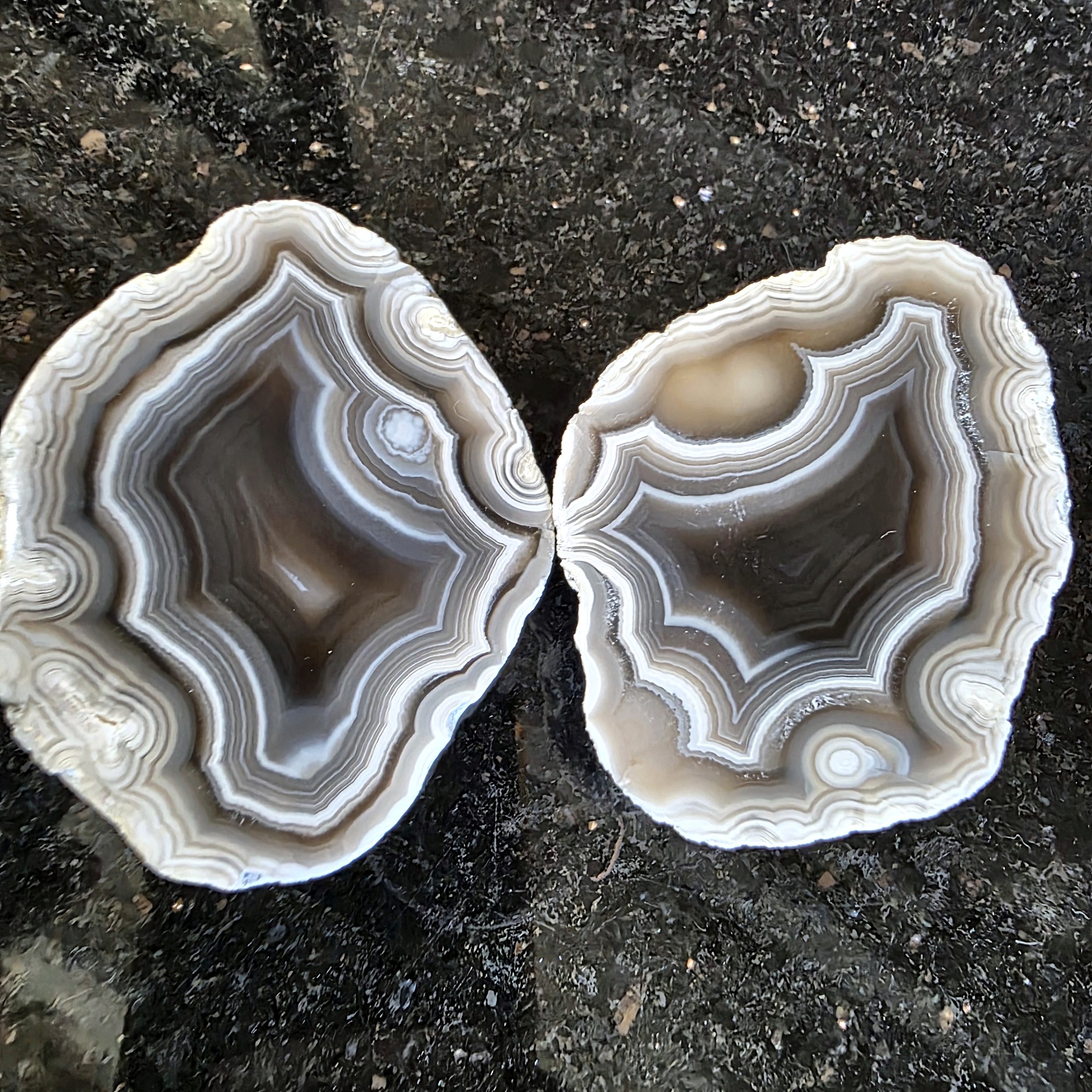
This Lebanese banded agate pair is a single natural nodule, cut and polished into two mirror-matched halves. Hand-collected on the Al-Minyeh coast of North Lebanon, it shows classic fortification banding in grey, taupe and white with a crystalline quartz centre. One-of-a-kind display piece — the exact stone pictured is the one you receive. Ships worldwide.
## What is this Lebanese banded agate pair?
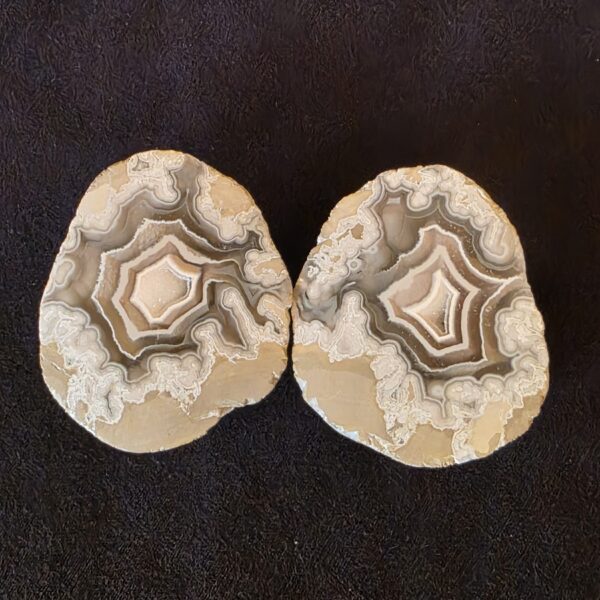
This is a natural banded agate pair, hand-collected on the Al-Minyeh coast of North Lebanon. A single agate nodule was cut and polished into two halves that mirror each other, so the banding on one face matches the other. You receive the exact pair shown in the photos.
The stone shows fortification agate banding — concentric grey, taupe and white layers that trace the outline of the original cavity — with a soft translucent centre and small crystalline quartz “eyes.” No dye, heat or treatment of any kind is used.
## Where does this agate come from?
It comes from the coast of Al-Minyeh in North Lebanon — a locality almost unknown in the international agate market. The banded agate here erodes from a Mio-Pliocene conglomerate formation in the hills above the coast and is carried down to the shore, where each nodule is collected by hand.
That origin makes every CedarAgate piece traceable to a specific place on the Lebanese coast. “Lebanese agate” is a genuinely rare locality — most banded agate on the market comes from Brazil, Botswana, Mexico or Madagascar.
## What makes fortification agate special?
Fortification agate is prized for its sharp, repeating bands that look like the walls of a fort seen from above. The pattern forms as silica-rich fluids deposit layer after layer inside a cavity over a very long time.
Because the two halves are split from one nodule, a matched pair like this shows the pattern twice, symmetrically — which is why collectors and decorators like to display the halves side by side, like natural bookends.
## Details & measurements
– **Stone type:** Natural agate (banded chalcedony)
– **Pattern:** Fortification / concentric banding
– **Colours:** Grey, taupe, cream and white, with a translucent quartz centre
– **Origin:** Al-Minyeh coast, North Lebanon
– **Piece:** Matched pair — two halves of one nodule, sold together
– **Finish:** One polished face on each half; natural cut edges
– **Dimensions (each half):** [LENGTH] × [WIDTH] × [DEPTH] cm ([convert to inches])
– **Combined weight:** [WEIGHT] g ([convert to oz])
– **Mohs hardness:** 6.5–7
– **Treatment:** None — 100% natural, undyed, unheated
– **Type:** One-of-a-kind; the pictured stone is the one shipped
## How to display it
Stand the two halves together as a symmetrical pair, or place one polished face up on a shelf, desk or windowsill where light can catch the translucent centre. In crystal traditions, agate is associated with grounding and calm — but this piece is sold as a natural display specimen, not for any health claim.
## Frequently asked questions
**Is this agate natural or dyed?**
It is 100% natural. No dye, heat or stabilisation is used — the grey-and-white colours are the stone’s own.
**Do the two halves really match?**
Yes. Both halves were cut from the same nodule, so the banding mirrors across the two faces.
**Where is Lebanese agate found?**
On the Al-Minyeh coast of North Lebanon, eroding from a conglomerate formation in the coastal hills. It is a rare locality with almost no presence in the global market.
**How big is it?**
Each half measures about [LENGTH] × [WIDTH] cm and the pair weighs [WEIGHT] g. See the in-hand photo for scale.
**Can it be used for jewellery?**
As sold it is a display pair, but the material is solid agate (Mohs 6.5–7) and can be cut into cabochons by a lapidary.
**Do you ship internationally?**
Yes — CedarAgate ships worldwide from Lebanon. Shipping is calculated at checkout.
Reviews
There are no reviews yet.